

Can I File Form 9465 if I Owe More Than $50,000?
Yes, you can still request a payment plan with the IRS if you owe more than $50,000, but the process is usually more involved. Taxpayers who want to set up … Read more
Yes, you can still request a payment plan with the IRS if you owe more than $50,000, but the process is usually more involved. Taxpayers who want to set up … Read more

IRS Form 941 must be filed four times each year by employers who pay wages subject to payroll taxes. Because it reports payroll tax withholding and employment taxes, the IRS … Read more

Employers who pay wages subject to payroll taxes are typically required to file IRS Form 941, Employer’s Quarterly Federal Tax Return. Because the form is filed four times per year, … Read more
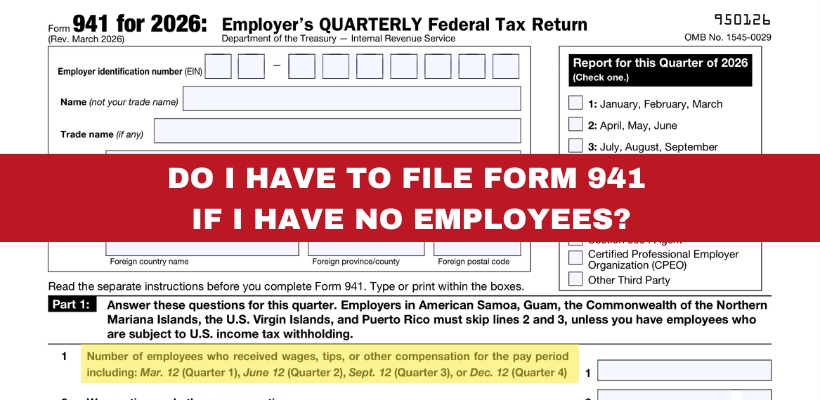
Many business owners become confused about IRS Form 941 requirements when their business has no employees. This situation is common for sole proprietors, single-member LLCs, or businesses that previously had … Read more
Many business owners assume that once they hire employees, they automatically have to file IRS Form 941, Employer’s Quarterly Federal Tax Return. While Form 941 is one of the most … Read more

According to the IRS, you can expect your IRS tax refunds 2026 in your bank account within 21 days or less, provided there are no errors in your tax return. … Read more

The IRS has officially opened the 2026 tax filing season, allowing taxpayers to begin submitting federal income tax returns for the 2025 tax year. As of January 26, the Internal … Read more

Falling behind on tax returns can happen for many reasons, including financial hardship, job changes, or simple oversight. If you have not filed in several years, one of the first … Read more

If the Internal Revenue Service (IRS) is taking money directly from your paycheck, you may be wondering: will bankruptcy stop wage garnishment? For many taxpayers facing IRS collection actions, bankruptcy … Read more

When you receive an official notice from the Internal Revenue Service, it usually comes with a deadline to respond. In many cases, you are given 30 days to file an … Read more

Many small business owners, freelancers, and independent contractors are surprised to learn that the IRS can levy the payments they receive from clients or vendors. This type of enforcement, known … Read more

An IRS levy does not only affect the money you have today. In many cases, the IRS can also seize your future federal tax refunds and apply them to your … Read more

Many taxpayers assume that when the IRS collection statute expires after 10 years, all tax problems disappear automatically. While it is true that IRS liens generally expire with the collection … Read more

The IRS has the authority to levy a portion of your Social Security benefits if you have unpaid tax debt, and this can come as a shock to many retirees … Read more

When the IRS levies your wages, bank account, or other assets, your top priority becomes getting the levy released as quickly as possible. A levy can disrupt your life overnight … Read more

The IRS’ Final Notice of Intent to Levy is one of the most serious tax notices you can get. This letter, officially known as Notice LT11 or Letter 1058, lets … Read more

Selling a home with an IRS lien can be challenging, but it is possible with proper planning. A federal tax lien attached to your property means that the IRS has … Read more

Many taxpayers worry that the IRS might file a federal tax lien without warning. The good news is that the IRS does notify you before filing a lien. In fact, … Read more

If you are wondering whether bankruptcy can stop an IRS levy, the answer is: in many cases, yes. When you file for bankruptcy, an automatic stay goes into effect. This … Read more

Many people who owe the IRS hope that bankruptcy will give them a fresh start. Bankruptcy can stop most collection actions, like wage garnishments or bank levies. But one common … Read more
Law Office of Steven N. Klitzner, P.A.
2627 N.E. Ives Dairy Road, Suite 213
Miami, FL 33180
Email: help@floridataxsolvers.com
Phone: 305-564-9199
Fax: 305-932-0605







Ⓒ 2024 Steven N. Klitzner. All rights reserved. | Privacy Policy | Terms of Service | Website by Vocational Media