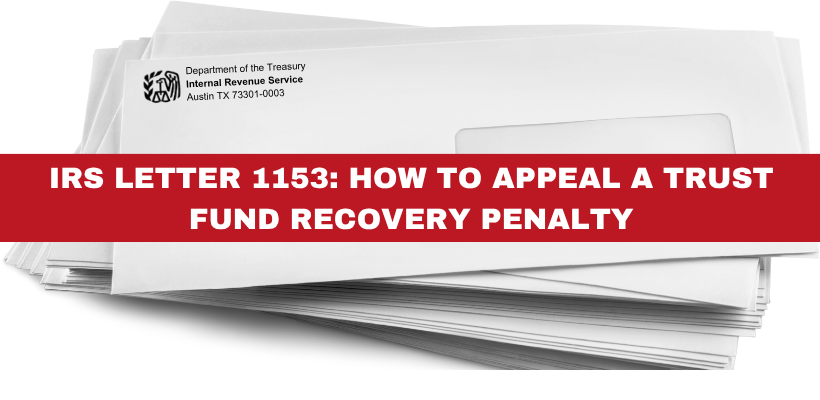
Receiving IRS Letter 1153 means the government intends to hold you personally responsible for certain unpaid payroll taxes. That can be alarming, especially when the taxes were owed by a corporation or another business entity. If the IRS assesses the Trust Fund Recovery Penalty, it may eventually pursue your personal wages, bank accounts, and property to collect the balance.
However, Letter 1153 is still a notice of a proposed assessment. You normally have a limited period to challenge the IRS’s findings before the penalty is assessed against you.
What Is IRS Letter 1153?
Letter 1153 is formally called the Proposed Trust Fund Recovery Penalty Notification. The IRS generally sends this letter after investigating a business that failed to pay its trust fund taxes. These taxes include federal income tax and the employee’s share of Social Security and Medicare taxes withheld from employee wages but not paid to the government.
Letter 1153 is usually accompanied by Form 2751, Proposed Assessment of Trust Fund Recovery Penalty. This form identifies the business, the tax periods involved, and the amount the IRS proposes to assess against you. Signing Form 2751 generally means that you agree with the proposed assessment. However, signing the form does not necessarily eliminate your appeal rights if you change your mind and submit a written protest before the deadline stated in Letter 1153.
Because of the amount that may be at stake, do not sign Form 2751 without understanding what it means for you personally.
Why Is the IRS Trying to Hold You Personally Responsible?
A corporation or limited liability company ordinarily creates some separation between business debts and personal debts. The Trust Fund Recovery Penalty is different.
The IRS may assess the penalty against a person who was both:
- Responsible for collecting, accounting for, or paying the trust fund taxes
- Willful in failing to make sure those taxes were paid
Both elements matter. Having one without the other may not be enough to support the penalty.
What Does It Mean to Be a Responsible Person?
The IRS does not determine responsibility based on job title alone. Being an owner, officer, director, or employee does not automatically make someone personally liable.
Instead, the IRS looks at the person’s actual authority and involvement in the business. It may examine who:
- Controlled the company’s bank accounts
- Had authority to sign checks
- Directed or approved payments
- Handled payroll or tax deposits
- Made financial decisions
- Had the authority to decide which creditors were paid
- Signed employment tax returns
- Had the ability to prevent the nonpayment
The IRS may investigate several people within the same business. More than one person can be considered responsible for the same unpaid trust fund taxes.
These questions are often discussed during a Form 4180 interview. The answers given during that interview can play an important role in the IRS’s decision to propose the penalty.
What Does Willfulness Mean?
The IRS must also determine that the failure to pay the taxes was willful.
In this context, willfulness does not necessarily mean that you intended to defraud the government. The IRS may find willfulness when someone knew, or should have known, that the payroll taxes were unpaid and allowed other creditors to be paid instead.
For example, the IRS may question why money was used to pay rent, suppliers, loan payments, or other operating expenses while withheld payroll taxes remained unpaid.
The timing of what you knew can be critical. Records showing when you first learned about the tax problem and what steps you took afterward may help explain your role.
How Long Do You Have to Appeal Letter 1153?
You generally have 60 days after Letter 1153 is mailed or personally delivered to submit a written appeal. If the letter is addressed to you outside the United States, the appeal period is generally 75 days.
The period begins the day after the letter is mailed or delivered. Your protest must generally be mailed, or faxed when permitted, by the applicable deadline.
Read the letter carefully and follow its instructions. Do not calculate the deadline based only on the day you opened the envelope.
If you miss the deadline, the IRS may assess the penalty and begin the collection process. You may still have other ways to challenge the assessment, such as paying the required amount and filing a refund claim, but those procedures can be more complicated.
What Should Your Appeal Include?
Your written protest should explain why you disagree with the proposed assessment. It should identify the business, the tax periods involved, and the IRS findings you are challenging.
The response should address responsibility, willfulness, or both. Depending on the facts of the case, useful supporting records may include:
- Corporate ownership records
- Bank signature cards
- Payroll records
- Canceled checks and bank statements
- Emails showing who made financial decisions
- Employment agreements
- Job descriptions
- Evidence that you could not access company accounts
- Records showing who controlled the business finances
- Documents showing when you learned about the unpaid taxes
- Evidence of steps you took to correct the problem
Simply stating that you were not responsible is unlikely to be enough. Your protest should explain what authority you actually had, who controlled the money, and what occurred during each disputed tax period.
The type of protest required may depend on the proposed penalty amount. Letter 1153 should include instructions explaining how and where to submit your appeal.
What Happens After You Submit an Appeal?
If your protest is timely, the revenue officer may first review the information to determine if it changes the proposed assessment. If the IRS does not agree with your position, the case may be forwarded to the IRS Independent Office of Appeals.
Appeals is separate from the IRS office that conducted the original investigation. You will have an opportunity to present your records and explain why you should not be held responsible for some or all of the proposed penalty.
Appeals may agree with the original determination, reduce the proposed penalty, remove certain tax periods, or decide that the penalty should not be assessed against you.
The result will depend on the evidence concerning your authority, financial control, actions, and knowledge during each period at issue.
Can the IRS Assess More Than One Person?
Yes. The IRS can assess the Trust Fund Recovery Penalty against more than one responsible person for the same business taxes.
For example, the IRS may pursue an owner, corporate officer, bookkeeper, payroll manager, or another person if the facts support responsibility and willfulness. However, the government cannot collect more than the total unpaid trust fund amount.
This means the IRS may continue collection against multiple responsible people until the trust fund portion of the business debt has been paid.
Final Thoughts
Letter 1153 is not an ordinary business tax notice. It means the IRS is preparing to transfer responsibility for certain unpaid payroll taxes from the business to you personally.
The appeal period gives you an opportunity to challenge that decision before the penalty is assessed. A strong response should focus on the authority you actually had, the financial decisions you could make, when you learned about the unpaid taxes, and what you did after learning about the problem.
Do not wait until the deadline is close before reviewing the letter and gathering records. The history of the business may cover several tax periods, and the documents needed to explain your role can take time to locate.
The Law Office of Steven N. Klitzner represents business owners, officers, employees, and other individuals facing Trust Fund Recovery Penalty investigations. Contact us if you received Letter 1153 or believe the IRS is preparing to hold you personally responsible for unpaid payroll taxes.
This article is provided for informational purposes only and does not constitute legal or tax advice. Reading this article does not create an attorney-client relationship. Every tax matter is different, and you should speak with a qualified tax professional about your specific circumstances.




 Steven N. Klitzner, P.A. is a tax attorney based in Miami, Florida. He has been practicing tax law for over 40 years, and currently holds a 10.0 rating by Avvo. Mr. Klitzner was appointed to the IRS Service Advisory Council in 2021 and is...