
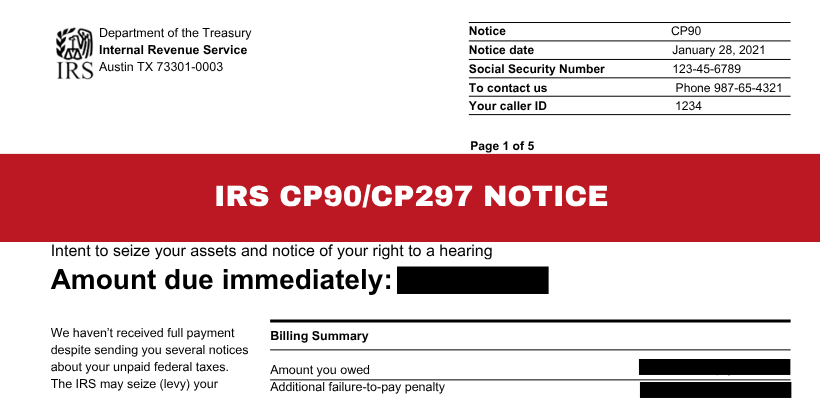
Opening a letter marked “Final Notice” can make it feel as though an IRS levy is about to happen immediately. IRS Notices CP90 and CP297 are serious collection notices, but they also provide an opportunity to challenge the proposed levy. The key is understanding the notice and responding before the deadline printed on it.
These notices generally do not mean that the IRS has already taken your money or property. They warn that the IRS intends to levy certain assets or federal payments for unpaid taxes. Ignoring the notice may allow the IRS to move forward with collection action.
What Do IRS Notices CP90 and CP297 Mean?
CP90 and CP297 are titled “Final Notice, Notice of Intent to Levy and Notice of Your Right to a Hearing.” The IRS sends these notices when taxes remain unpaid and it is preparing to take collection action. Both notices provide the right to request a Collection Due Process hearing with the IRS Independent Office of Appeals.
These notices are commonly associated with the Federal Payment Levy Program. Through this program, the IRS may collect unpaid taxes from certain federal payments owed to the taxpayer. Depending on the account, those payments may include federal retirement benefits, contractor payments, vendor payments, or certain Social Security benefits.
A levy is the legal seizure of property to pay a tax debt. The IRS may also levy bank funds, wages, accounts receivable, or other property in some cases. CP90 and CP297 serve as warnings that stronger collection action may be approaching.
CP90 is generally issued for an individual tax account, while CP297 is generally issued for a business tax account. A CP90 may involve personal income taxes or another individual liability. A CP297 may involve payroll taxes, business income taxes, excise taxes, civil penalties, or another business-related debt.
How Long Do You Have to Request a Hearing?
You generally have 30 days from the date of the CP90 or CP297 to request a Collection Due Process hearing. The exact deadline should appear on the notice, and you should follow the submission instructions carefully. The deadline is based on the notice date, not the day you opened the envelope.
A hearing is normally requested by completing Form 12153, Request for a Collection Due Process or Equivalent Hearing. The form should identify the tax periods involved and explain why you disagree with the proposed levy or what collection alternative you want the IRS to consider. Including a copy of the CP90 or CP297 may help the IRS match the request to the correct account.
Send the form to the hearing-request address shown on the notice, which may be different from the payment address. Keep a copy of the form, the notice, and proof of when the request was sent. Calling the IRS about the balance does not necessarily preserve your hearing rights or extend the filing deadline.
What Happens If You Request a CDP Hearing?
A timely Collection Due Process hearing request allows the IRS Independent Office of Appeals to review the proposed levy. You may raise concerns about the collection process or propose another way to resolve the debt. Possible collection alternatives include an installment agreement, offer in compromise, or currently not collectible status.
Appeals may request financial statements, income records, bank statements, expense documentation, and filed tax returns. You may also be able to raise issues involving missing payments, innocent spouse relief, taxes discharged in bankruptcy, or the amount of the liability in limited circumstances. Learn more about what you can discuss at an IRS Collection Due Process hearing.
The IRS generally pauses the levy action covered by the hearing while a timely request is pending. Interest and applicable penalties may continue to accrue, and requesting a hearing does not automatically approve a payment plan or another resolution. If you disagree with the Appeals determination, you may also have the right to request review by the United States Tax Court.
If you miss the 30-day deadline, you may still be able to request an Equivalent Hearing within the applicable one-year period. However, an Equivalent Hearing provides fewer protections and generally does not give you the right to challenge the outcome in Tax Court. Learn more about what happens if you miss the CDP hearing deadline.
What Should You Do After Receiving CP90 or CP297?
Start by reviewing the name, tax periods, tax forms, balance, and deadline listed on the notice. Compare the information with your records and determine whether the balance is correct. You should also confirm whether all required tax returns have been filed.
If you cannot pay the full balance, you may still have options. Depending on your financial circumstances, the IRS may consider monthly payments, a reduced settlement, or a temporary delay in collection. Business taxpayers may also need to address current payroll deposits or other filing obligations before the IRS considers a resolution.
Do not assume that submitting a payment proposal will automatically stop the hearing deadline. Protecting your appeal rights and negotiating a collection alternative may need to happen at the same time. Waiting for the IRS to respond to a phone call or pending request could allow the deadline to pass.
Final Thoughts
Receiving a CP90 or CP297 can feel like the IRS has already reached the end of the road. In reality, the notice may still give you a short window to challenge the proposed levy and have your case reviewed by Appeals. That window is easy to lose, though, because the 30-day deadline continues to run even while you are trying to sort out the balance, gather records, or speak with the IRS.
If you received one of these notices, it is worth looking beyond the words “Final Notice” and focusing on the rights and deadlines printed inside. The Law Office of Steven N. Klitzner can review your CP90 or CP297, help you understand what the IRS is proposing, prepare a timely hearing request, and represent you before the IRS Independent Office of Appeals. Contact us to discuss your notice before the opportunity to request a CDP hearing expires.





 Steven N. Klitzner, P.A. is a tax attorney based in Miami, Florida. He has been practicing tax law for over 40 years, and currently holds a 10.0 rating by Avvo. Mr. Klitzner was appointed to the IRS Service Advisory Council in 2021 and is...