
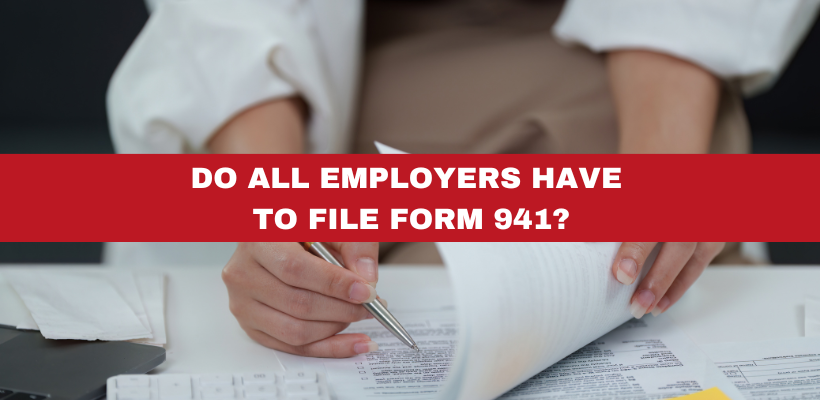
Many business owners assume that once they hire employees, they automatically have to file IRS Form 941, Employer’s Quarterly Federal Tax Return. While Form 941 is one of the most common payroll tax forms employers file, not every employer is required to submit it.
Understanding who must file Form 941 (and who does not) can help businesses avoid filing errors, missed deadlines, or unnecessary IRS notices.
What Is IRS Form 941?
Form 941 is used by employers to report federal payroll taxes withheld from employees’ wages. This includes:
- Federal income tax withheld from employees
- The employer and employee share of Social Security tax
- The employer and employee share of Medicare tax
Employers typically file this form four times a year (once per quarter) to report the total wages paid and payroll taxes owed during that period.
Do All Employers Have to File Form 941?
No. Not all employers are required to file Form 941.
Generally, an employer must file Form 941 if they pay wages subject to federal income tax withholding or Social Security and Medicare taxes. However, there are several exceptions.
Employers Who Usually Must File Form 941
Most businesses with employees must file Form 941 if they:
- Pay wages that are subject to federal income tax withholding
- Withhold Social Security and Medicare taxes from employees
- Have regular payroll activity during the quarter
This typically includes businesses such as Corporations, Partnerships, LLCs with employees, or sole proprietors with employees.
Even small businesses with only one employee may still need to file Form 941.
Employers Who Do NOT File Form 941
Some employers report payroll taxes using different forms instead of Form 941.
- Small Employers Filing Form 944
Some small employers are instructed by the IRS to file Form 944 (Employer’s Annual Federal Tax Return) instead of Form 941.
Form 944 allows qualifying employers with very small payroll tax liability to report taxes once per year rather than quarterly.
However, employers cannot choose this on their own. The IRS must notify the employer that they are eligible to file Form 944.
- Employers of Household Employees
If you hire household employees such as nannies, caregivers, or housekeepers, you typically report those payroll taxes on Schedule H (Form 1040) rathern than Form 941.
- Employers of Agricultural Workers
Agricultural employers generally report payroll taxes using Form 943 (Employer’s Annual Federal Tax Return for Agricultural Employees) instead of Form 941.
- Employers With No Payroll
If a business has no employees and no wages paid, it usually does not need to file Form 941.
However, once a business starts paying wages, the filing requirement usually begins.
What Happens If You Should File Form 941 but Don’t?
Failing to file Form 941 when required can lead to IRS penalties. These may include:
- Failure-to-file penalties
- Failure-to-pay penalties
- Interest on unpaid payroll taxes
Payroll tax issues are taken seriously by the IRS because employers are responsible for holding payroll taxes “in trust” for the government. If the IRS believes payroll taxes were not properly reported or paid, it may also pursue the Trust Fund Recovery Penalty (TFRP) against responsible individuals.
Final Thoughts
While most employers with employees must file Form 941, there are several exceptions. Some businesses file Form 944, Form 943, or Schedule H instead, depending on the type of employees they have and their payroll tax obligations.
If you are unsure whether your business should be filing Form 941, it may be worth reviewing your payroll tax filings or speaking with a tax professional. Filing the wrong form or failing to file the correct one can lead to IRS notices and penalties.




 Steven N. Klitzner, P.A. is a tax attorney based in Miami, Florida. He has been practicing tax law for over 40 years, and currently holds a 10.0 rating by Avvo. Mr. Klitzner was appointed to the IRS Service Advisory Council in 2021 and is...